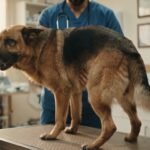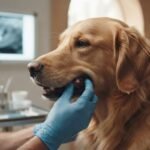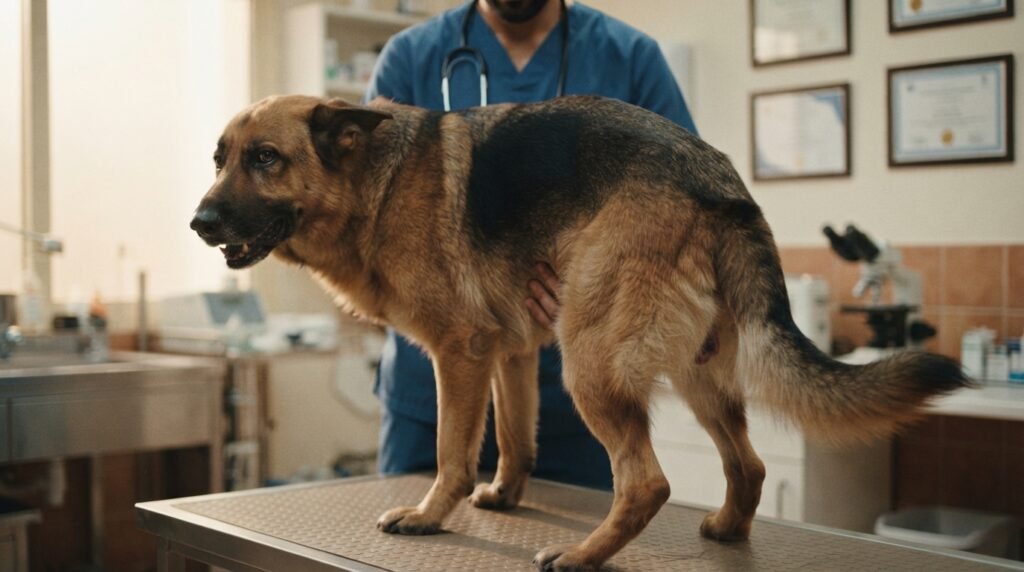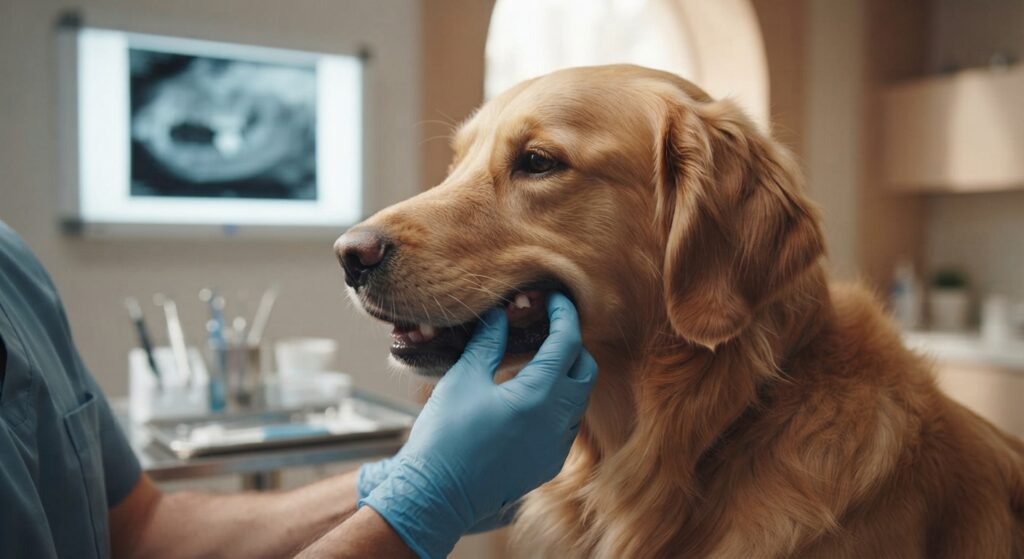
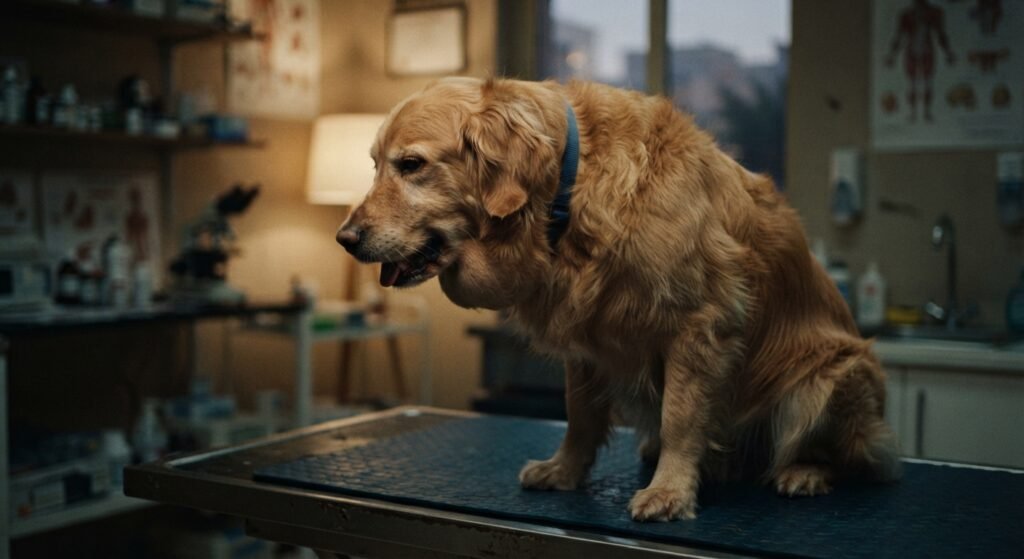
Canine sialadenosis, when repeated swallowing and gagging lead the examination somewhere unexpected.
The dog keeps swallowing.
Not after eating, and not necessarily before vomiting. It may begin while resting: several exaggerated swallowing movements, a sudden gag, then another attempt to swallow. Sometimes there is excessive saliva. Sometimes nothing comes up at all.
The history sounds gastrointestinal. Reflux, nausea or oesophageal irritation would be reasonable considerations.
But during the physical examination, another finding changes the direction of the investigation.
Beneath the jaw, the mandibular salivary glands are enlarged.
The question is no longer simply why the dog keeps retching. It is whether the swallowing episodes and the glandular enlargement belong to the same disease process.
The finding that is easy to overlook
Sialadenosis is an uncommon disorder characterised by enlargement of the salivary glands without the inflammation or neoplastic changes that would ordinarily explain their increased size.
In dogs, the mandibular glands are frequently involved, sometimes bilaterally.
What makes the condition clinically unusual is the apparent distance between the owner’s complaint and the anatomical finding.
The owner describes retching, gagging, persistent swallowing or episodes of excessive salivation. These signs naturally direct attention towards the stomach and oesophagus.
Yet palpation of the head and neck may reveal glandular enlargement that the owner has never noticed.
The glands may be enlarged without obvious discomfort, although painful presentations have also been reported.
Their presence does not establish sialadenosis. It does, however, make an exclusively gastrointestinal explanation less convincing.
When the pattern matters more than the episode
One of the more distinctive observations in reported cases is the repetitive, sometimes abrupt nature of the swallowing and retching.
Some dogs have episodes several times throughout the day. Excitement can precipitate them. Others show persistent lip-smacking, excessive salivation or apparent difficulty swallowing.
The distinction between vomiting, regurgitation, gagging and repeated swallowing becomes important here.
A dog that actively vomits stomach contents presents a different clinical problem from one that repeatedly gulps without expelling anything.
When these episodes recur despite treatment directed towards suspected gastrointestinal disease, we consider whether the original diagnosis adequately explains the findings.
Particularly when the mandibular salivary glands are enlarged.
It is the coexistence of the two findings — abnormal swallowing behaviour and salivary-gland enlargement — that makes sialadenosis worth considering.
Why an enlarged gland is not yet a diagnosis
Salivary-gland enlargement has several potential explanations.
Inflammation, salivary mucoceles, obstruction and neoplasia can all produce abnormalities around the jaw or upper neck. Nearby lymph nodes and other structures may also be mistaken for salivary-gland enlargement.
The investigation therefore begins by establishing which structure is abnormal and what kind of process is affecting it.
Ultrasound can help evaluate glandular architecture and surrounding tissues. Depending on the findings, cytology, further imaging or tissue sampling may be indicated.
Histopathology can be important in excluding inflammatory or neoplastic conditions. In sialadenosis, the absence of significant pathological changes must be interpreted alongside the clinical presentation rather than treated as a diagnosis in isolation.
A careful oral, pharyngeal and gastrointestinal assessment may also be needed.
The purpose is not to search for an unusual diagnosis before common explanations have been considered.
It is to avoid overlooking a relevant physical finding because the presenting signs appear to belong to another organ system.
An unexpected response that raises further questions
Some reported cases of canine sialadenosis show a marked response to phenobarbital, a medication more commonly associated with seizure management.
That observation has prompted investigation into possible neurological or autonomic mechanisms underlying the disorder.
However, the precise mechanism remains uncertain, and a response to medication does not independently establish the diagnosis.
The significance of these reports is clinical: a syndrome presenting with apparent gastrointestinal discomfort may involve mechanisms that extend beyond the digestive tract.
It is one reason accurate diagnosis matters before treatment is selected.
The examination we would not want to miss
At Hub Clinics, recurrent gagging or exaggerated swallowing warrants an assessment of the full clinical picture, particularly when previous treatment has failed to explain or resolve the episodes.
We want to know what happens immediately before the behaviour, whether the dog produces vomit or simply retches, and whether the episodes occur during meals, excitement or rest.
A home video can be especially useful when the behaviour is intermittent.
We also want to examine the mouth, pharynx and structures beneath the jaw, rather than allowing a presumed gastrointestinal complaint to define the entire consultation.
For dogs experiencing persistent gagging, retching or repeated swallowing in Dubai and Sharjah, a veterinary assessment can help determine whether the source is gastrointestinal, oral, pharyngeal or associated with another disease process.
At Hub Clinics, our diagnostic approach depends on reconciling what owners observe with what the physical examination reveals.
Because occasionally, the finding that explains why a dog keeps trying to swallow is not discovered by examining the stomach.
It is found just beneath the jaw.
Hub Clinics – For the life you share.
Hub Pet Veterinary Clinic | Arjan, Dubai
Hub Vet Veterinary Clinic | Sharjah