Feline Tritrichomonas infection, when an otherwise healthy kitten presents with a very specific pattern of intestinal disease.
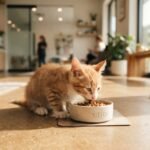
The kitten is gaining weight. Its appetite is excellent. It plays, explores and behaves exactly as a young cat should.
But the litter box tells a different story.
The stools remain soft, sometimes almost liquid, with an unusually offensive smell. There may be mucus, occasional streaks of fresh blood or several unsuccessful attempts to defecate.
A course of treatment appears to help. The stool becomes more formed for a few days, then deteriorates again.
For us, the discrepancy is worth examining: the kitten appears clinically well, yet the large intestine is behaving as though the inflammation never resolved.
The history changes what we look for
When investigating persistent diarrhoea in a young cat, we pay close attention to the character of the stool rather than its consistency alone.
Frequent passage of small amounts of faeces, mucus, fresh blood and straining point towards inflammation of the large intestine.
The next question concerns the kitten’s history.
Has it recently come from a breeder, shelter or rescue environment? Was it housed with several other cats? Have the symptoms persisted despite previous parasite treatment?
These details raise suspicion for feline Tritrichomonas infection, particularly Tritrichomonas blagburni, historically referred to as Tritrichomonas foetus.
It is an infection we consider when the clinical picture is dominated by recurrent large-bowel diarrhoea in a kitten that otherwise remains remarkably bright.
The absence of weight loss or systemic illness does not make the history insignificant.
Why a negative faecal examination may not settle the question
A routine faecal examination is a reasonable starting point for many kittens with diarrhoea. It can help identify common intestinal parasites.
However, a negative result does not necessarily exclude Tritrichomonas.
The organism can be observed moving in a freshly collected faecal wet preparation, but detection depends on the condition of the sample, the number of organisms present and the examination technique.
An ordinary faecal flotation test is not a reliable method of excluding this infection.
This distinction becomes important when a kitten has undergone repeated routine faecal examinations without a convincing explanation for the symptoms.
Repeating the same test may be less useful than asking whether the suspected organism requires a different diagnostic method.
The sample matters as much as the test
When the clinical history raises sufficient suspicion, a targeted faecal PCR test can help identify Tritrichomonas DNA.
PCR is generally more sensitive than direct microscopy, but even this result requires interpretation.
The quality of the sample matters. Fresh diarrhoeic faeces containing mucus may provide more useful material than a small quantity of dry or normally formed stool. In selected cases, a veterinary-collected sample using a faecal loop or colonic flush may improve detection.
A negative result does not always resolve the suspicion, particularly if sample collection was suboptimal.
Equally, a positive PCR result does not automatically prove that Tritrichomonas is the only cause of diarrhoea. Some infected cats carry the organism without displaying clinical signs.
The diagnosis needs to make sense alongside the stool pattern, the cat’s history and the results of any additional investigations.
Why repeated treatment can become part of the problem
One of the more frustrating patterns is a kitten that receives successive courses of empirical treatment without a confirmed diagnosis.
Diet changes, antibiotics and parasite treatments may produce temporary changes in stool consistency without addressing the underlying cause.
Repeated interventions can also complicate interpretation of the intestinal response.
Treatment for confirmed feline trichomonosis requires particular care. Ronidazole, sometimes used for this infection, is not licensed for cats in many jurisdictions and carries a risk of neurological toxicity.
It is not a medication to prescribe simply because a kitten has persistent diarrhoea.
This is where a targeted diagnostic approach becomes more valuable than another treatment trial.
The kitten that looks well still deserves an explanation
At Hub Clinics, a kitten with recurrent, foul-smelling diarrhoea, mucus or straining warrants a review of more than its diet and previous medications.
We want to know how long the symptoms have persisted, what the stool actually looks like, whether other cats are affected and exactly which organisms have already been investigated.
These details help determine whether a targeted Tritrichomonas PCR or a broader investigation is appropriate.
For kittens with persistent diarrhoea in Dubai or Sharjah, we recommend a veterinary assessment rather than repeatedly changing food or restarting medication without identifying the cause.
A kitten that develops dehydration, marked lethargy, repeated vomiting or reduced appetite requires prompt attention.
At Hub Clinics, we believe the diagnostic value of a test depends on the clinical question that led us to request it.
Because a kitten can continue growing, eating and playing while a significant intestinal infection remains unresolved.
Sometimes the most revealing finding is how little the kitten appears affected by a problem that refuses to disappear.
Hub Clinics – For the life you share.
Hub Pet Veterinary Clinic | Arjan, Dubai
Hub Vet Veterinary Clinic | Sharjah